Article: Compression Therapy: What the Research Actually Shows About Recovery and Circulation
Compression Therapy: What the Research Actually Shows About Recovery and Circulation
Compression boots have become a familiar sight courtside, trackside, and now in living rooms — the inflatable, sequentially-squeezing sleeves that athletes strap on the moment a workout ends. But the underlying technology, intermittent pneumatic compression (IPC), didn't start in sports medicine at all. It started in hospitals, where it's been used for decades to keep blood moving in patients who can't move themselves, preventing dangerous clots after surgery.
That dual identity is what makes compression therapy an interesting category to evaluate honestly. On one hand, IPC has one of the more genuinely well-established medical evidence bases of any recovery tool on this list. On the other, the specific claims made about athletic recovery — faster soreness relief, better performance, quicker "bounce back" — are newer, thinner, and worth looking at with real scrutiny rather than taking on faith. This guide walks through what's actually been measured, where the evidence is strong, where it's still catching up, and how to think about which compression tool fits your goals.
What Compression Therapy Actually Does in the Body
Intermittent pneumatic compression works through a straightforward mechanical principle: inflatable chambers squeeze a limb in sequence, from the foot or ankle upward, mimicking the way skeletal muscle normally contracts to push blood back toward the heart through the veins.
Venous return and circulation. Veins don't pump blood on their own — they rely on surrounding muscle contractions and one-way valves to keep blood moving against gravity. When you're inactive (after surgery, on a long flight, or simply sitting all day), that return flow slows down and blood can pool in the lower legs. Sequential compression physically replicates the muscle-pump action, pushing pooled blood and fluid back toward central circulation. This is the core mechanism behind essentially every claimed benefit of compression therapy, medical or athletic.
The strongest evidence base: clot prevention. This is worth stating plainly, because it's the part of the story wellness marketing tends to skip. IPC's best-documented effect isn't muscle soreness — it's preventing dangerous blood clots. A meta-analysis of 15 randomized controlled trials in over 2,100 postoperative patients found that prophylactic IPC use reduced the risk of deep vein thrombosis (DVT) by 60% compared to no compression, a large and statistically significant effect. Johns Hopkins Medicine describes the same mechanism in plain terms: the cuffs "squeeze your legs," which "helps move blood through your veins towards your heart," and the devices also appear to trigger some of the body's natural clot-prevention processes. This is decades-old, clinically established use — the wearable recovery boots people buy for home use are a newer, lower-pressure descendant of the same underlying technology.
Fluid shifts and perceived recovery. In athletic contexts, researchers have also looked at whether compression changes measurable blood markers after exercise. One study found that sequential compression reduced post-exercise hemodilution — essentially, it helped blood composition return toward baseline faster than passive rest — and improved how recovered athletes felt on a standard perceptual recovery scale (Sport Sciences for Health). That's a real, measurable physiological effect. Whether it translates into anything you can perform better at is a separate question — and the same study found it, notably, did not: cycling power output in the next exercise bout was essentially identical whether athletes used compression or not (400.1W vs. 398.3W). The honest takeaway is that compression can change how you feel without necessarily changing what your body can do next — an important distinction to hold onto as you read the sections below.
How Compression Therapy Can Support Specific Concerns
Muscle soreness and DOMS
This is where most of the athletic recovery research has concentrated, and the results are genuinely mixed — encouraging for soreness specifically, less so for other markers.
The most comprehensive look at this question is a 2024 systematic review and meta-analysis in *Biology of Sport*, which pooled 17 randomized controlled trials on lower-limb IPC and sports recovery. For pain and soreness, the effect was real: a significant small effect immediately after exercise, growing to a moderate effect at 48 hours, and a significant small effect still present at 96 hours — timing that the authors note "coincides with the peak values of DOMS," suggesting compression may be most useful right around when soreness peaks. But the same review found only trivial-to-small, non-significant effects on actual muscular function and performance, and highly inconsistent results for blood markers of muscle damage (creatine kinase), with some studies showing benefit and others showing none (Biology of Sport).
The review is also candid about why some caution is warranted: none of the 17 studies reported allocation concealment, only about a third blinded participants, and sample sizes were generally small — all of which make it more likely that some of the soreness benefit reflects expectation rather than pure physiology. That doesn't erase the finding, but it's a good reason not to oversell it.
A separate 2025 study in *Scientific Reports* on combat sports athletes found a similar pattern with a twist on timing: cold compression was more effective at reducing soreness immediately after exercise, while pneumatic compression's soreness-reducing effect showed up later, at 48 hours — and higher-pressure pneumatic compression (100 mmHg) outperformed lower pressure (25 mmHg) for maintaining muscle elasticity over that window (Scientific Reports). Pressure and timing both appear to matter, not just whether you use compression at all.
Circulation and swelling
The clearest, best-supported use case for compression therapy has nothing to do with athletics — it's managing fluid pooling and swelling in the legs, which is the mechanism the DVT-prevention research above is built on. Anyone who spends long stretches sitting or standing (a long flight, a long shift on your feet, a day of travel) experiences a milder version of the same sluggish venous return that compression is designed to counteract, which is why sequential compression's "flush" effect is so consistently associated with reduced puffiness and that heavy, tired-legs feeling.
Perceived recovery vs. actual performance
This is the nuance most worth sitting with. Across the studies above, a consistent pattern emerges: people using compression therapy report feeling more recovered, and some physiological markers (like hematocrit returning to baseline) move in a favorable direction — but objective performance measures don't reliably follow. The cycling study above is the clearest example: better perceptual recovery scores, identical power output. That's not a reason to dismiss compression therapy — feeling less sore and more ready to train again has real value on its own — but it's a reason to be skeptical of any claim that compression boots will make your next workout measurably better, rather than just make the wait until it feel easier.
Choosing Your Compression Therapy Tool
HEALiX Flow IPC Boots — for everyday post-training recovery
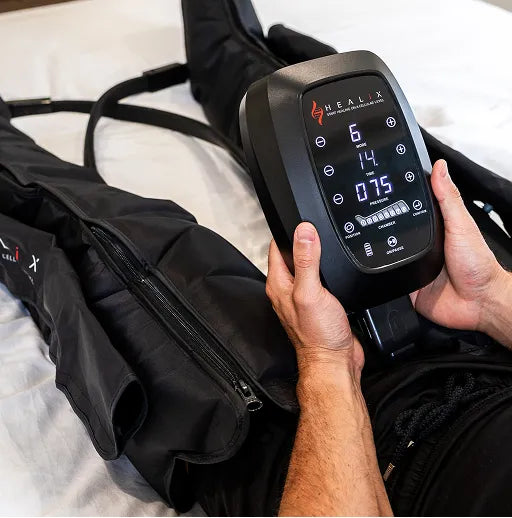
The Flow IPC Boots bring the same sequential compression technology described above into a cordless, wearable format built for regular use after training. Five overlapping air chambers per boot inflate and deflate in sequence, applying the pulsating, sequential pressure that moves fluid the way the research above describes.
Key things to know:
• 5 overlapping air chambers per boot with 3 preset massage programs, plus an adjustable pressure range of 80–200 mmHg across 5 levels — in the same range used in the sports-recovery research cited above.
• Built-in LCD touchscreen on each boot and a rechargeable internal battery, so there's no separate console or cord to manage.
• Available in Medium (fits roughly 5'2"–5'8") and Large (roughly 5'8"–6'2"); covered by a 2-year warranty and 45-day return window.
• A practical session, per the research above, runs 15–30 minutes — no need to guess at duration.
HEALiX Flow Pro Compression Boots — for a more targeted, higher-intensity routine
The Flow Pro steps up from the standard Flow IPC Boots with a multi-chamber system that allows individually targeted chamber control, customizable pressure settings, and adjustable massage patterns — built for the kind of granular, personalized session that higher training loads call for, rather than a fixed preset.
Key things to know:
• Multi-chamber compression with individual chamber targeting, plus fully customizable pressure and massage pattern settings.
• Designed for higher-intensity or higher-frequency training recovery — endurance athletes, high-frequency trainers, and anyone whose current preset-based routine feels like it's hit a ceiling.
• Available in Medium, Large, and Extra Large for a closer size fit.
• Like the standard boots, a typical session runs 20–30 minutes depending on training load and recovery goal.
Frequently Asked Questions
Is compression therapy a treatment for a medical condition?
No. Compression boots for home and athletic use are wellness and recovery tools, not medical devices, and they aren't a substitute for care from your doctor. The strongest clinical evidence for pneumatic compression comes from hospital-grade DVT prevention, a different application at different pressures under medical supervision — not a claim that at-home recovery boots treat any diagnosed condition.
Who shouldn't use compression boots?
Anyone with a known or suspected blood clot (DVT), severe arterial disease or poor circulation, serious heart failure, an active infection, leg ulcers or open wounds, or unexplained swelling should get medical clearance before using compression therapy. Johns Hopkins Medicine specifically flags peripheral vascular disease and skin breakdown risk as reasons to involve a provider first.
Will compression boots actually help me perform better in my next workout?
The honest answer is: probably not directly. The best current research shows compression can improve how recovered you feel and shift some blood markers favorably, but it hasn't reliably shown up as better performance in the very next session. Feeling more ready to train again is a real benefit — just not the same claim as "performance enhancement."
How much soreness relief should I actually expect?
Based on the 2024 *Biology of Sport* meta-analysis, expect a modest but real reduction in perceived soreness, most noticeable in the 48-hour window after hard training — right around when DOMS typically peaks. Don't expect a dramatic change in measurable muscle damage markers or next-day strength.
How is the Flow Pro different from the standard Flow IPC Boots?
The Flow IPC Boots use a 5-chamber system with 3 preset programs — straightforward and effective for regular post-training use. The Flow Pro adds individually targeted chamber control and fully customizable pressure and massage patterns, aimed at people whose training load calls for a more precise, adjustable session.
How often can I use compression boots?
Daily use is generally fine for healthy users without contraindications; a practical routine for most people is 3–5 sessions a week timed to harder training days, with each session running 15–30 minutes.
A Grounded Next Step
Compression therapy has an unusual profile among recovery tools: a genuinely strong medical evidence base for its original purpose (circulation and clot prevention), and a newer, more modest — but real — evidence base for the soreness relief people reach for after training. Both can be true at once. The research doesn't support treating compression boots as a performance enhancer, but it does support them as a legitimate tool for feeling less sore and more ready to get back to training, particularly in that 48-hour window when soreness tends to peak.
If you're not sure whether the standard Flow IPC Boots or the more targeted Flow Pro fits your routine, reach out — we're happy to help you figure out which option matches your training load and recovery goals.
This article is for general educational purposes and is not a substitute for professional medical advice. Compression therapy is a complementary wellness practice, not a treatment for any medical condition. Please consult your physician before starting compression therapy if you have a history of blood clots, arterial disease, heart failure, active infection, or unexplained swelling.
Further Reading & Sources
• Johns Hopkins Medicine — DVT Prevention: Intermittent Pneumatic Compression Devices