Massage Chairs and the At-Home Recovery Ritual
For the past few years, wellness culture pushed people toward more data: track your HRV, your sleep score, your recovery readiness, your macros. The Global Wellness Summit's 2026 trend report names the counter-movement to that as one of the year's defining themes: an "over-optimization backlash" that favors meaning over measurement, and a renewed interest in rituals that help people feel restored rather than just quantified.
That shift shows up concretely in how people are furnishing their homes. Industry trend coverage points to a rise in home recovery technology, smart lighting, sleep-focused setups, and recovery devices people use on a regular cadence rather than as a one-time purchase. A massage chair fits squarely into that category: it's not something you check a number on afterward, it's something you sit in.
That's exactly why it's worth looking at honestly. A daily or weekly ritual is only worth building around a tool that does something real. This article walks through what mechanical massage chairs have actually been shown to do, where the evidence is solid, where it's thinner than the marketing suggests, and how to think about building one into a routine.
What a Massage Chair Actually Does in the Body
Modern massage chairs combine several distinct mechanical inputs, and it's worth separating them because the research doesn't treat them as one interchangeable thing.
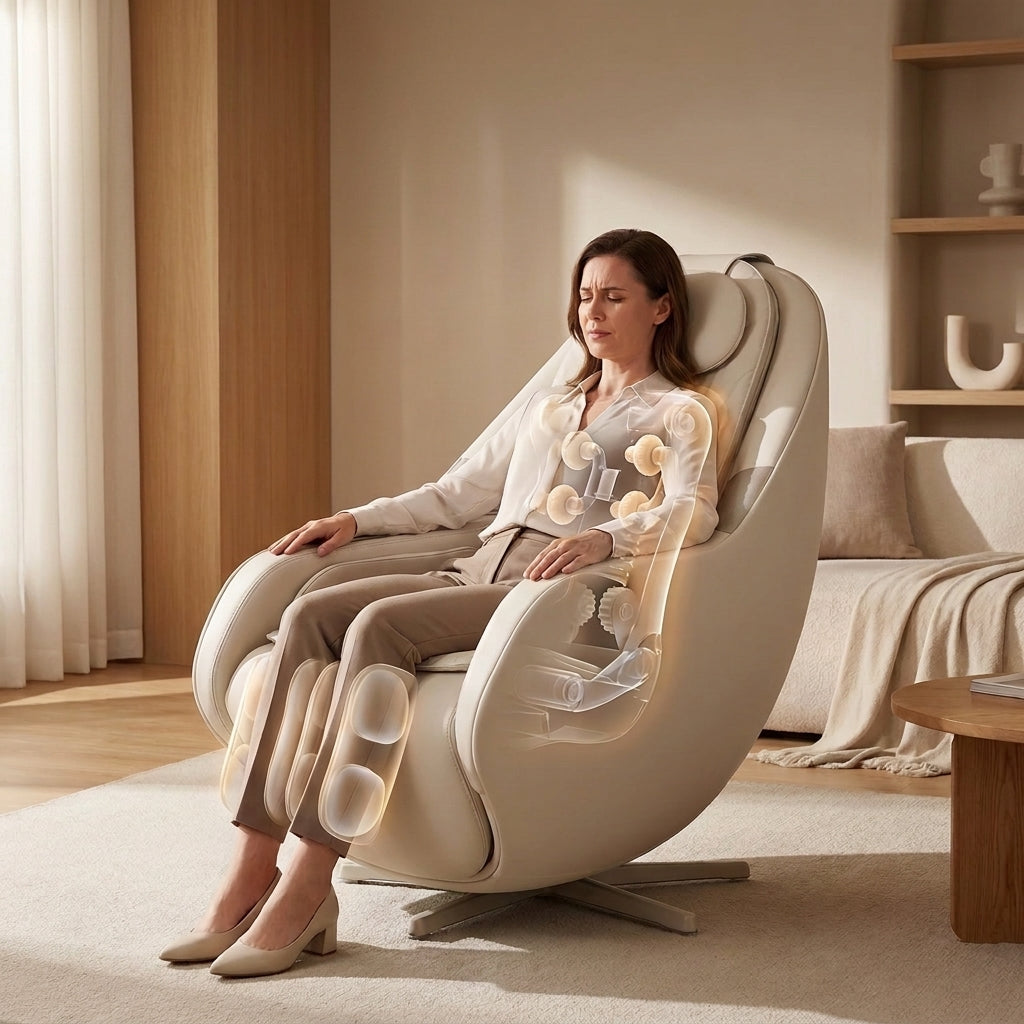
Roller tracks. Motorized rollers move along a track that traces the spine, delivering kneading, tapping, rolling, or shiatsu-style pressure to the muscles on either side of it. The track length and shape (2D, 3D, or 4D systems) determine how closely the rollers can follow an individual's actual spinal curve versus a generic path.
Air compression. Airbags built into the seat, armrests, calves, and feet inflate and deflate in sequence, applying the same kind of intermittent pneumatic compression used in dedicated compression therapy devices, just distributed across more of the body at once. This is the mechanism most directly tied to circulation and the "flushed, less puffy" feeling many users report in the legs and feet.
Heat. Many chairs add localized heat, typically along the lower back, which increases local blood flow and can make the underlying muscle tissue more receptive to the mechanical pressure from the rollers and airbags.
Zero-gravity positioning. Borrowed from the neutral body posture NASA identified for astronauts during launch, a zero-gravity recline distributes body weight evenly across the seat and reduces the load on the lower spine, which is part of why many chairs combine this position with lower-back-focused massage programs.
Taken together, these mechanisms are doing something mechanically like what a human massage therapist and a compression device would do in combination. The open question, and the one the research below actually addresses, is how to measure the benefit that combining modalities produces.
What the Research Actually Shows
Low Back Pain: Massage Chair vs. Physiotherapy
The most rigorous head-to-head study on massage chairs is a randomized controlled trial published in the journal *Medicine*, which compared massage chair therapy directly against standard physiotherapy in patients with chronic lower back pain. Fifty-six participants were split between a physiotherapy group (ultrasound, TENS, interferential current, and hot packs) and a massage chair group (20-minute sessions combining stretching, vibration, stroke mode, and heat), each completing six sessions over three weeks (Medicine, via Ovid).
Both groups improved significantly on pain scores (p < .001), which is the headline finding worth sitting with: a massage chair produced a real, statistically significant reduction in chronic low back pain, not just a placebo-level shift. Physiotherapy did edge out the massage chair on the specific numbers, a 1.73-point improvement on a 10-point pain scale versus 1.16 for the chair (p = .03), and a similar pattern held for the functional rating index used to assess quality of life. There was no significant difference between groups in patient satisfaction.
The part of the study that matters most for an at-home context is the cost-effectiveness comparison: the massage chair protocol cost roughly 60% of the physiotherapy program per treatment cycle, for a smaller but still real clinical benefit. The honest reading isn't "massage chairs beat physical therapy." It's that supervised physiotherapy remains the stronger clinical intervention, and a massage chair is a legitimate, well-studied, lower-cost option for people managing chronic low back pain who can't access or afford regular clinic visits, particularly as an ongoing maintenance tool between or alongside professional care.
Stress and Cortisol: The Workplace Study
The best-designed study on massage chairs and stress physiology comes from a Swedish workplace pilot published in *Frontiers in Public Health*, which randomized 93 employees across four workplaces into five groups: mechanical massage alone, mechanical massage combined with mental training, mental training alone, a passive seated pause with no intervention, and a true control group that continued normal work (Frontiers in Public Health).
The massage intervention used a mechanical massage chair delivering programmed massage to the neck, shoulders, back, and calves in 15-minute sessions, three times a week, over eight weeks, close to what a home user might realistically do. The results were mixed in an instructive way. Heart rate variability (a common marker of parasympathetic, "rest and recover" nervous system activity) showed no significant differences between groups over time. But blood plasma cortisol, a direct stress hormone marker, dropped significantly in the massage-only group between weeks four and eight (from an average of 19.77 to 15.96, p < .05), a pattern not seen in the other four groups, including the mental-training and passive-pause conditions.
That's a real, physiologically measured stress-reduction effect, and it's worth being precise about what it does and doesn't show: the cortisol benefit took several weeks of consistent use to appear, it didn't show up in HRV, and this was one pilot-scale study rather than a large, confirmed trial. It's a genuinely encouraging early result for a stress-focused ritual, not proof of a broad relaxation effect across every physiological marker researchers might measure.
Blood Pressure and Circulation: Where the Evidence Is Thinner
Blood pressure reduction is one of the most common claims in massage chair marketing, and it's worth being straightforward about the state of the evidence: chair-specific research with clear methodology and numeric results is genuinely hard to find. Broader massage therapy research (using human therapists, not chairs) does show short-term blood pressure reductions in some studies, and the air-compression mechanism described above shares its underlying logic with the well-documented circulation benefits of dedicated compression therapy devices. But a search of the available literature turns up mostly general claims rather than the kind of controlled, chair-specific trial data seen in the low back pain and cortisol studies above. If circulation and blood pressure are a primary goal, it's fair to treat this as a plausible extension of related research rather than a directly proven outcome for massage chairs specifically.
Building It Into an At-Home Recovery Ritual
The trend research behind this article points to something worth taking seriously: the value of a ritual isn't only in the physiological effect, it's in having a consistent, low-effort practice that doesn't require tracking a score afterward. The studies above actually support that framing. The cortisol benefit in the Swedish workplace study only appeared after weeks of consistent use, not a single session, and the low back pain trial was built around a defined three-week course rather than sporadic use.
A few practical takeaways follow directly from the research: consistency matters more than session length, several short sessions a week outperformed occasional long ones in the studies above; heat and compression appear to be doing real mechanical work, so programs that combine them with roller massage are working with the grain of the research rather than against it; and the honest expectation is meaningful relief and stress reduction over weeks, not a single dramatic session.
Frequently Asked Questions
Can a massage chair actually treat chronic low back pain?
The best available evidence says it can meaningfully reduce pain, based on a randomized controlled trial showing statistically significant improvement. It's not as effective as supervised physiotherapy in that same study, and it isn't a diagnosis or treatment for an underlying medical condition, but it's a legitimate, evidence-backed tool for pain management.
How long before I'd notice a stress-reduction effect?
Based on the Swedish workplace study, the measurable cortisol reduction appeared between weeks four and eight of consistent use (15 minutes, three times a week), not immediately. Expect a ritual that builds over a couple of months, not an instant reset.
Do massage chairs lower blood pressure?
This is a commonly repeated claim, but well-designed, chair-specific research on blood pressure is limited. There's a reasonable mechanical case for it given how air compression and heat affect circulation, but it hasn't been established with the same rigor as the pain and cortisol findings above.
Is a massage chair a substitute for physical therapy?
No. In the head-to-head trial above, physiotherapy produced a larger clinical improvement. A massage chair is better understood as a complementary, lower-cost tool, useful for ongoing maintenance or for people without regular access to clinical care, not a replacement for a prescribed treatment plan.
How often should I actually use one?
The research reviewed here used short, frequent sessions, around 15 to 20 minutes, three times a week, rather than long occasional ones. That's a reasonable starting cadence if you're building a routine around either pain management or stress reduction.
Is there a risk to daily use?
Neither study referenced here reported adverse events from regular use. As with any mechanical therapy applied to the spine and joints, anyone with a recent injury, a spinal condition, a pacemaker, or who is pregnant should check with a physician before starting a regular massage chair routine.
A Grounded Next Step
Massage chairs have real, if still-developing, research behind them: a randomized trial showing genuine pain relief for chronic low back pain, and a workplace study showing a measurable stress hormone reduction after weeks of consistent use. Neither study supports treating a massage chair as a cure or a replacement for medical care, and the blood pressure claims common in marketing are running ahead of the specific evidence. What the research does support is something more modest and, frankly, more useful: a consistent, low-effort ritual that produces real physiological change over time, which is exactly the kind of wellness practice the current trend data suggests people are looking for.
If you're thinking about building a recovery ritual around consistent, low-effort sessions rather than another thing to track, we're happy to help you think through what a realistic routine looks like for your space and your goals.
This article is for general educational purposes and is not a substitute for professional medical advice. Massage chairs are a complementary wellness practice, not a treatment for any diagnosed medical condition. Please consult your physician before starting regular massage chair use if you have a recent injury, a spinal condition, a pacemaker or other implanted device, or are pregnant.
Further Reading & Sources
● Global Wellness Institute, Global Wellness Summit Releases 10 Wellness Trends for 2026
● Dr. Axe, Wellness Trends 2026: Personalization, Prevention & Real-Life Well-Being Take Over