Article: Navigating Menopause Naturally: How Infrared Therapy Can Support Your Body Through Change
Navigating Menopause Naturally: How Infrared Therapy Can Support Your Body Through Change
Navigating Menopause Naturally:
How Infrared Therapy Can Support Your Body Through Change
Menopause is not a single event — it's a years-long transition that touches nearly every system in the body. Hot flashes get most of the attention, but women moving through perimenopause, menopause, and post menopause also commonly deal with joint aches, disrupted sleep, mood swings, skin and hair changes, and a general sense of inflammation that wasn't there before. The Mayo Clinic and Cleveland Clinic both note that declining estrogen affects far more than reproductive health — it influences temperature regulation, joint and connective tissue, sleep architecture, mood, and skin.
For many women, this is the point where they start looking for tools that work with their body rather than against it. That's where infrared-based therapies — red light therapy, infrared saunas, and infrared mats — have earned a growing following. None of these are a cure or a replacement for medical care, and every woman's experience of menopause is different. But there's a meaningful and growing body of research suggesting that heat and light therapies can support the body's natural processes around inflammation, circulation, pain, sleep, and stress during this transition.
This guide walks through what's actually happening in the body during menopause, what the research says about infrared and red-light therapy, and how to think about which product might be the right fit for you.
What's Really Happening in the Body During Menopause
Before looking at solutions, it helps to understand the “why” behind the symptoms.
Vasomotor symptoms (hot flashes and night sweats). These are the hallmark of menopause, caused by estrogen's effect on the body's internal thermostat in the hypothalamus. They can disrupt sleep, work, and daily comfort for years.
Joint pain and inflammation. Estrogen plays a role in regulating inflammation and maintaining cartilage and connective tissue. As levels drop, many women notice new or worsening joint stiffness and aches — sometimes called “menopausal arthralgia.” GoodRx and other clinical resources point to this as one of the most under-discussed symptoms of the transition.
Sleep disruption. Beyond night sweats, hormonal shifts affect sleep architecture directly. A 2024 review in the journal Menopause highlights how sleep disturbance during this stage is both common and closely tied to other symptoms like mood and cognitive fog.
Mood and stress. Estrogen and progesterone interact with neurotransmitters that regulate mood. Harvard Medicine Magazine and the American Psychological Association both describe an increased vulnerability to anxiety and low mood during perimenopause and menopause, even in women with no prior history.
Skin and connective tissue changes. Estrogen supports collagen production. Its decline is linked to thinner, less elastic skin and slower tissue repair — one reason many women notice skin changes accelerate around this time.
This is a lot for one hormonal shift to touch — which is part of why a whole-body approach, rather than chasing a single symptom, tends to serve women better.
The Science Behind Infrared and Red Light Therapy
Two related but distinct technologies show up in this conversation, and it's worth knowing the difference:
Red light therapy (photobiomodulation) uses specific wavelengths of red and near-infrared light that penetrate the skin to interact with cells, particularly the mitochondria. Research reviews describe photobiomodulation's effects on reducing inflammatory markers and modulating pain signaling, which is why it shows up in dermatology, sports recovery, and pain management settings (PubMed: Mechanisms and applications of the anti-inflammatory effects of photobiomodulation; PubMed: Photobiomodulation therapy reduces acute pain and inflammation).
Infrared heat (saunas and mats) uses infrared wavelengths to gently warm the body directly, rather than heating the surrounding air the way a traditional sauna does. This deeper, more tolerable heat is associated with increased circulation, sweating, and a cardiovascular response similar to moderate exercise. A systematic review in PMC on far-infrared therapy found supportive evidence across a range of chronic conditions involving circulation and inflammation, and the Cleveland Clinic outlines benefits ranging from improved circulation to relaxation and potential pain relief.
Neither technology is marketed or should be understood as a treatment for menopause itself. What the research does support is their role in supporting circulation, easing musculoskeletal discomfort, calming the nervous system, and supporting skin health — all of which overlap directly with the symptoms described above.
How Each Product Can Support You
Red Light Therapy Couch — for whole-body inflammation, joint comfort, and skin support
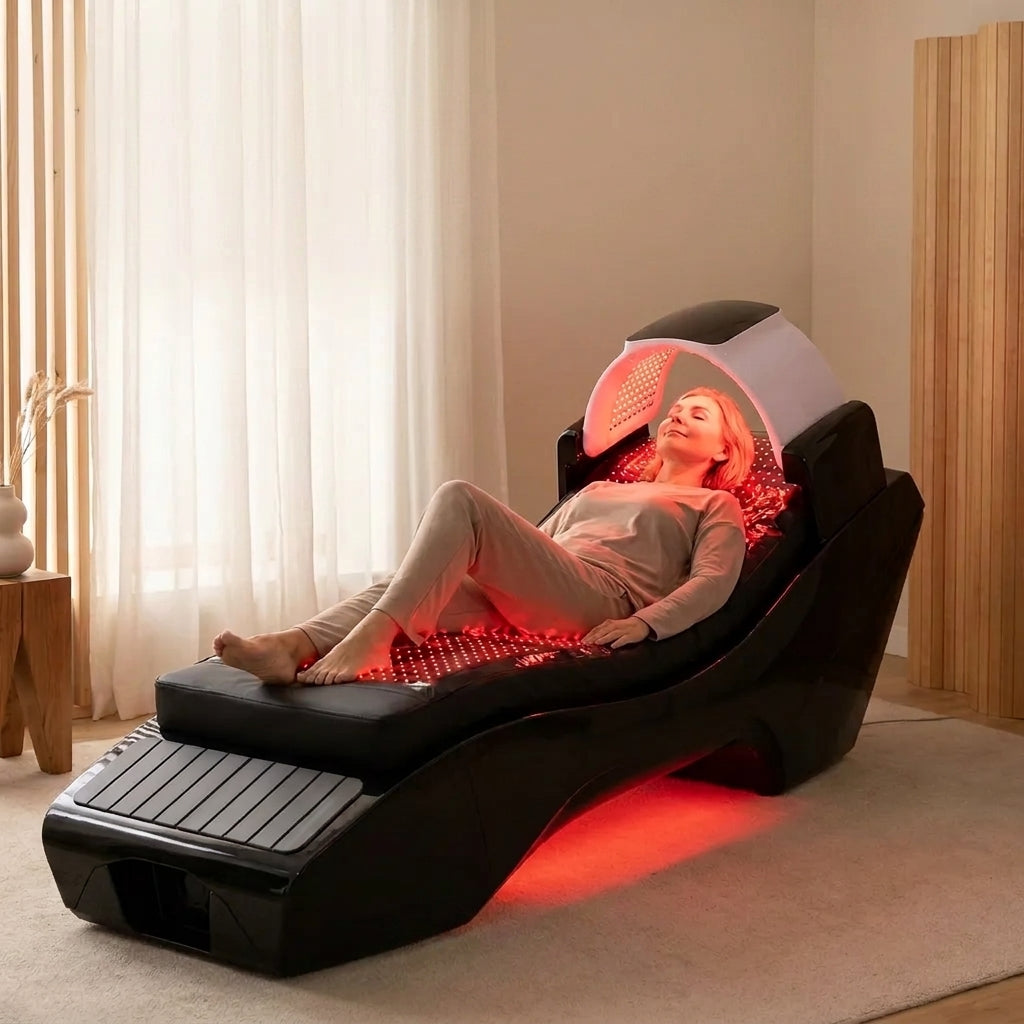
A full-body red light therapy couch delivers photobiomodulation across large areas at once, which is particularly relevant for the joint and muscle aches so many women describe during perimenopause and beyond. Because the light also stimulates collagen-related cellular activity, it's frequently used to support skin tone and elasticity — addressing two menopause-related concerns (joint discomfort and skin changes) in a single session.
Key things to know:
• Sessions are typically short (10–20 minutes) and require no downtime — you can use it fully clothed or unclothed depending on the treatment area.
• Consistency matters more than intensity; most people notice benefits build over several weeks of regular use rather than after one session.
• It's a passive, low-effort addition to a routine — helpful for days when joint pain makes more vigorous recovery tools less appealing.
Infrared Sauna — for circulation, stress relief, and sleep support
Infrared saunas heat the body at a lower ambient temperature than traditional saunas, which many women find more comfortable — especially if hot flashes already make heat sensitivity a concern (more on that in the FAQ below). The gentle cardiovascular workout of an infrared sauna session, paired with the relaxation response it triggers, is commonly used to support circulation, ease muscle tension, and unwind the nervous system before bed, which can help with the sleep disruption so common in menopause.
Key things to know:
• Start with shorter sessions (10–15 minutes) at a lower temperature, especially if you experience hot flashes, and build up gradually.
• Hydration before and after each session is essential.
• Evening sessions are popular among women using infrared sauna as part of a wind-down routine to support sleep.
Infrared/PEMF Mat — for targeted, everyday relief
An infrared mat brings many of the same deep-heat benefits as a sauna into a more targeted, low-commitment format — often combining far-infrared heat with other elements like negative ions or gemstones depending on the model. It's especially popular for women managing localized joint or lower-back discomfort who want something they can use daily at home while reading, working, or relaxing in the evening.
Key things to know:
• Because sessions can be done lying down with no setup, it's often the easiest entry point for daily use.
• Effects are typically felt as warmth-driven muscle relaxation and improved local circulation, similar in principle to a heating pad but with deeper, more even heat penetration.
• A good option to layer alongside a sauna or red light couch, or as a standalone starting point.
Frequently Asked Questions
Is infrared or red-light therapy a treatment for menopause?
No. These therapies are not medical treatments or hormone therapy, and they aren't a substitute for care from your doctor or menopause specialist. They're best understood as supportive wellness tools that may help ease specific symptoms — like joint discomfort, tension, and stress — that often accompany the menopause transition.
I get hot flashes. Is an infrared sauna a bad idea?
Not necessarily, but it's worth being thoughtful. Infrared saunas heat the body directly at lower ambient air temperatures than traditional saunas, which some women find more tolerable. Still, if heat is a known hot-flash trigger for you, start with short, low-temperature sessions, stay well hydrated, and stop if you feel overheated. If you have a cardiovascular condition or are pregnant, talk to your doctor first — sauna use isn't recommended during pregnancy.
How soon will I notice a difference?
This varies widely by person and by symptom. Many people report feeling more relaxed or noticing eased muscle tension after a single session, while changes in joint comfort or skin appearance are generally reported after consistent use over several weeks.
Can I use red light therapy and infrared heat together?
Yes — many women incorporate both into their routine, for example using a red-light session on non-sauna days, or an infrared mat for daily maintenance between sauna sessions. There's no evidence they conflict; they simply work through different mechanisms (light-based cellular activity versus heat-based circulation and relaxation).
Are there people who shouldn't use these therapies?
Yes. Pregnant women, people with certain cardiovascular conditions, uncontrolled blood pressure, or a history of heat intolerance should speak with their doctor before starting infrared sauna use. Anyone on medication that affects heat regulation or photosensitivity should also check with their healthcare provider before starting red light therapy or sauna use.
Do I need to buy all three products?
Not at all. Many women start with one — often whichever addresses their most pressing symptom, whether that's joint pain, sleep, or stress — and add others later. Think of them as complementary tools rather than a required set.
A Gentle Next Step
Menopause is a transition, not a problem to be fixed — but that doesn't mean you have to just push through the discomfort. Whether it's the deep, targeted relief of a red-light therapy couch, the full-body reset of an infrared sauna, or the easy daily warmth of an infrared mat, these tools are meant to give your body more support as it moves through this stage of life.
If you're not sure where to start, reach out — we're happy to help you think through which option fits your symptoms, your space, and your routine.
This article is for general educational purposes and is not a substitute for professional medical advice. Please consult your physician or menopause specialist before starting any new wellness therapy, especially if you are pregnant, have a cardiovascular condition, or are managing a chronic illness.
Further Reading & Sources
• Mayo Clinic — Menopause: Symptoms and Causes
• Cleveland Clinic — Unusual Symptoms of Perimenopause and Low Estrogen
• Cleveland Clinic — Infrared Saunas: What They Do and 6 Health Benefits
• GoodRx — Menopause and Joint Pain: Causes and Treatment Options
• Harvard Medicine Magazine — The Mental Health Aspects of Menopause
• American Psychological Association — Menopause Can Be Rough. Psychology Is Here to Help
• PubMed — Mechanisms and Applications of the Anti-Inflammatory Effects of Photobiomodulation
• PubMed — Photobiomodulation Therapy Reduces Acute Pain and Inflammation