At-Home Vagus Nerve Stimulation: How the Device Works
At-Home Vagus Nerve Stimulation: How the Device Works
Vagus nerve stimulation is having a moment. Health outlets are calling vagus nerve exercises one of the defining wellness trends of 2026, and the usual list gets passed around constantly: humming, gargling, extended exhales, splashing cold water on your face. Those are free, approachable, and genuinely rooted in biology. But there's a reason a separate category of dedicated at-home devices exists alongside them, and it's worth understanding what these devices are actually doing before buying one, or before trying to explain to a customer why a device might do more than a thirty-second trick learned from a video.
This guide covers the mechanism behind at-home vagus nerve stimulation, what early clinical research has found so far, how it differs from the implanted medical version, and the safety basics anyone should know first. The tone here is intentionally cautious. This is a genuinely promising and fast-moving area of neuroscience, and also one where consumer marketing frequently runs ahead of the evidence.
What the Vagus Nerve Actually Does
The vagus nerve is the longest cranial nerve in the body, running from the brainstem down through the neck, chest, and abdomen, and it's the main channel of the parasympathetic, or "rest and digest," branch of the autonomic nervous system. It helps regulate heart rate, breathing, digestion, and the body's return to a calm state once a stressor has passed. "Vagal tone," often estimated through heart rate variability (HRV), is a rough proxy researchers use for how flexibly the nervous system can shift between stress and recovery.
Most of the nerve runs deep inside the body, out of reach for any external device. But two small branches surface close enough to the skin to be reached without surgery: one at the ear, specifically a region called the cymba conchae, and one at the neck, near the carotid sheath. Both are external, accessible points to the same internal nerve, and they're the reason ear-clip and neck-worn devices exist at all.
Two Very Different Categories of "Non-Invasive VNS"
This is where it's worth being precise, because the term "vagus nerve stimulation" covers a wide range of devices with very different levels of evidence and regulatory status behind them.
Implanted VNS is the original medical version: a surgically placed device that wraps around the vagus nerve directly, cleared for drug-resistant epilepsy and, in some cases, treatment-resistant depression. It's invasive, requires a procedure, and isn't the category any at-home product falls into.
Clinically cleared non-invasive devices sit in the middle. A small number of handheld, neck-applied non-invasive VNS devices have earned specific FDA clearance for a narrow medical indication, most notably the acute treatment of pain associated with migraine and cluster headache, each backed by its own dedicated clinical trial program. These devices are an important reference point because they prove non-invasive vagus nerve stimulation can clear a real regulatory bar.
Consumer wellness devices, the ear-clip and neck-worn products marketed for stress, HRV, sleep, and focus, are the category most at-home VNS devices actually fall into. Many of these are registered as general wellness devices rather than cleared medical treatments for a specific condition. That doesn't mean there's no evidence behind them, but it does mean the regulatory bar they've cleared is different and lower.
What Early Studies Have Found So Far
The research specific to neck worn or ear-based stimulation (known in the literature as transcutaneous auricular vagus nerve stimulation, or taVNS) is still early, but it's real and growing.
A study published in PeerJ used a single-blinded crossover design with 28 healthy young adults, comparing active stimulation at the cymba conchae against a sham location on the outer ear. After just ten minutes, the active stimulation group had measurably better HRV outcomes than the sham group, with both RMSSD and SDNN (two standard time-domain HRV measures) improving, along with an increase in high-frequency power, the component most closely tied to parasympathetic activity. No adverse effects were reported (PeerJ).
A separate double-blind, randomized, sham-controlled trial, published in Frontiers in Integrative Neuroscience in 2024, tested 25 Hz stimulation at the left cymba conchae for 20 minutes per session, across three alternating days, in 42 university students. Anxiety scores on the Beck Anxiety Inventory dropped from an average of 9.3 to 4.1, a statistically significant change that held up at a two-week follow-up. Muscle tension also decreased, and no adverse events were reported. The researchers point to several possible mechanisms, including activation of the cholinergic anti-inflammatory pathway and effects on brain regions tied to anxiety regulation, like the amygdala and prefrontal cortex (Frontiers in Integrative Neuroscience).
Both studies are small, use healthy or student populations rather than clinical ones, and measure effects over days or weeks, not months. Read together, they're a genuinely encouraging early signal for how neck and ear-based stimulation interacts with the autonomic nervous system, not yet a settled verdict on long-term benefit. Larger trials with longer follow-up are still needed before anyone can say with confidence how durable these effects are outside a lab setting.
How an At-Home VNS Device Fits a Recovery Routine
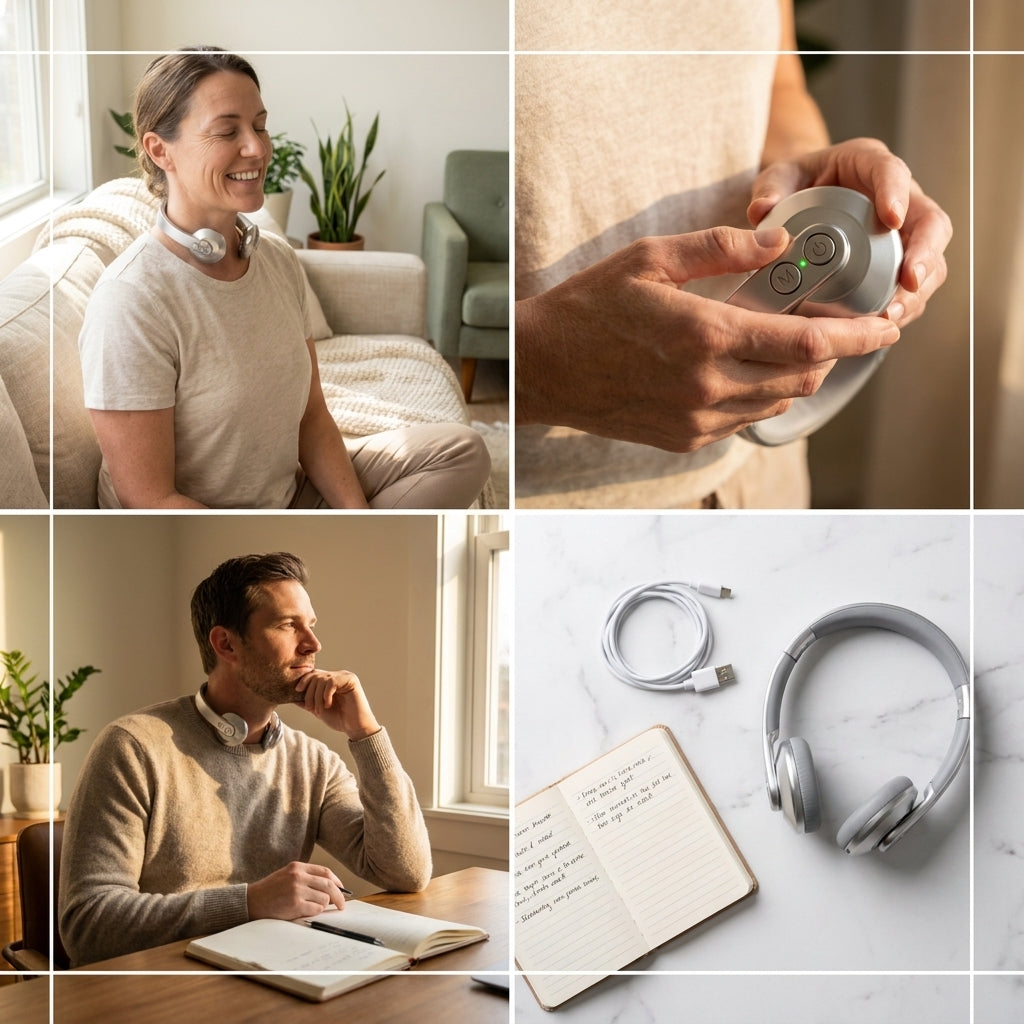
An at-home VNS device occupies a different niche than sauna, cold plunge, or PEMF. It requires no heat tolerance, no cold exposure, and no undressing, and sessions in the research above ran 10 to 20 minutes. That makes it one of the lowest-effort tools in a recovery routine, something that can realistically happen at a desk, on a couch, or before bed.
Key things to know:
- Session length in the published studies was short, 10 to 20 minutes, not an all-day wear protocol.
- The strongest anxiety result above came from repeated sessions across several days, not a single use, so consistency matters more than any one session.
- A device gives a controlled, repeatable dose at a known location on the ear or neck, which is the main difference from free techniques like humming or cold water exposure. Those are a reasonable starting point, but they're hard to standardize or measure, and a device is built to apply the same stimulation the same way every time.
See how our Vagus Nerve Stimulation Device fits into a low-effort daily routine: Science-Backed Deep Relaxation Vagus Nerve Stimulator
Safety and Who Should Check With a Doctor First
Non-invasive doesn't mean risk-free, and at-home VNS devices come with real precautions.
People should talk to a doctor before use if they have a pacemaker or other implanted electronic device, a seizure disorder, a diagnosed heart condition, carotid artery disease or a history of carotid surgery, or if they're pregnant, since safety data for pregnancy doesn't currently exist. These devices also aren't intended for children, and anyone with broken, infected, or irritated skin at the contact site should wait until it heals.
Reported side effects in the studies above were mild: tingling at the electrode site, occasional light-headedness, and drowsiness afterward are the most common. Anyone experiencing real pain (not tingling), persistent dizziness, a change in heart rhythm, or skin irritation that doesn't resolve should stop and check with a doctor.
Frequently Asked Questions
Is this the same thing as the humming, gargling, and cold water tricks everyone's posting about? They work through a related idea, reaching the vagus nerve to encourage a parasympathetic shift, but they're not interchangeable. Humming, gargling, and cold exposure are free and accessible, but hard to standardize from one try to the next. A device applies a fixed, repeatable stimulation at a known location and intensity, which is closer to what was actually used in the studies above.
Is my device FDA-cleared to treat anxiety? Check this directly rather than assume. Most consumer ear-clip and neck-worn VNS devices marketed for stress, sleep, or HRV are registered as general wellness products, not cleared medical treatments for anxiety or any other condition. A small number of neck-applied devices do hold specific FDA clearances, but only for migraine pain and cluster headache, not anxiety or stress. Confirm what your specific device's packaging or regulatory filing actually says before making a treatment claim.
How long until I'd notice anything? The HRV study above found measurable changes after a single 10-minute session. The anxiety study used three sessions across alternating days to see its biggest effect. Neither study followed participants for more than two weeks, so there isn't yet a clear answer for what, if anything, changes over months of regular use.
Can I use this alongside sauna, cold plunge, or PEMF? There's no published research testing these tools in combination, so no study backs up a specific stacking order or claims a bigger combined effect. Many people use a VNS device at a different time of day than sauna or cold plunge simply because it requires so little setup, not because any research says combining them works better.
Who definitely shouldn't use an at-home VNS device without medical guidance first? Anyone with a pacemaker or other implanted electronic device, a seizure disorder, a diagnosed heart condition, carotid artery disease, or who is pregnant. This list isn't exhaustive, and a quick conversation with a doctor is a reasonable step for anyone managing a chronic health condition.
A Grounded Next Step
At-home vagus nerve stimulation sits in a genuinely interesting spot right now: a real, physiologically specific mechanism, a small but growing body of controlled research, and a consumer market moving faster than the science has fully caught up to. The early numbers on HRV and anxiety are worth paying attention to, and they're also based on small samples and short follow-up periods, which is simply an honest description of where this field currently stands.
If you're curious whether a dedicated device belongs in your routine alongside the trend of free vagus nerve exercises everywhere right now, we're happy to walk through how it works, how long sessions actually take, and where it fits next to the rest of your recovery tools.
Shop our Vagus Nerve Stimulation Device: Science-Backed Deep Relaxation Vagus Nerve Stimulator
This article is for general educational purposes and is not a substitute for professional medical advice. At-home vagus nerve stimulation devices are wellness tools, not treatments for anxiety, depression, or any diagnosed condition, unless your specific device carries a regulatory clearance that says otherwise. Please consult your physician before starting vagus nerve stimulation, especially if you have an implanted electronic device, a seizure disorder, a heart condition, carotid artery disease, or are pregnant.
Further Reading & Sources
- Cleveland Clinic: Vagus Nerve, What It Is, Function, Location & Conditions
- PeerJ: Ear Your Heart, Transcutaneous Auricular Vagus Nerve Stimulation on Heart Rate Variability in Healthy Young Participants
- Frontiers in Integrative Neuroscience: Transcutaneous Auricular Vagus Nerve Stimulation Trial (2024)
- Wikipedia: Overview of Non-Invasive Vagus Nerve Stimulation Devices, Including FDA-Cleared Clearances
- Yahoo Health: Vagus Nerve Exercises to Try in 2026
- Verified Market Research via Yahoo Finance: Vagus Nerve Stimulation Market Forecast