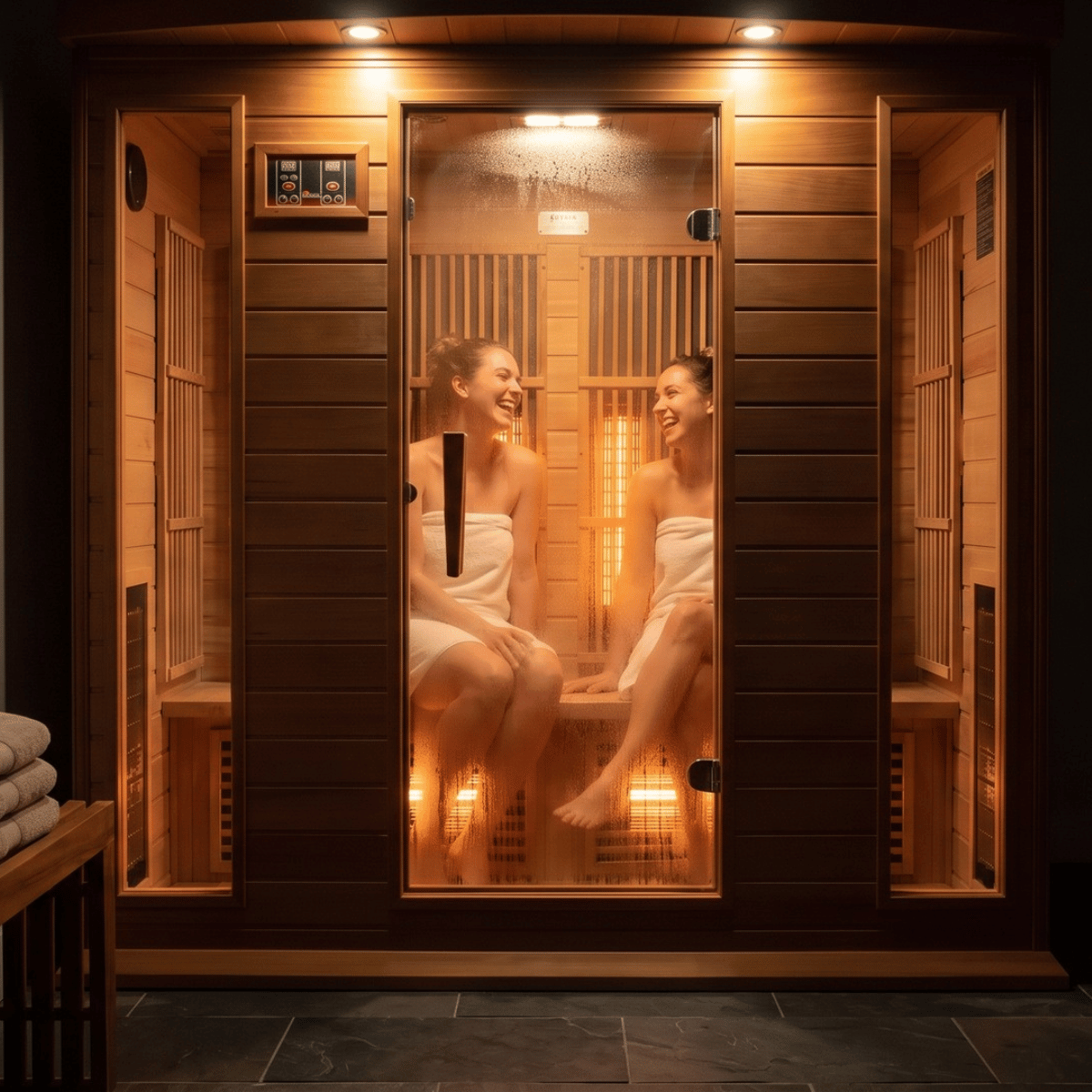
The Social Sauna: Why Sweating Together Is One of 2026's Biggest Wellness Trends
For most of the last decade, wellness culture pushed people toward solitary optimization: track your HRV, your sleep score, your recovery readiness, alone, in silence, with your phone doing the measuring. The Global Wellness Summit's 2026 trend report names the countermovement explicitly, calling out "sauna raves" alongside sober dance events and grief raves as part of what it calls the "festivalization of wellness," communal, in-person experiences built on "joy, belonging and expression rather than discipline and endless optimization."
That shift is showing up in real venues, not just trend decks. Community bathhouses are opening across major cities, and the pitch is explicitly social: in London, friends are reportedly swapping "let's grab a couple of pints" for "let's meet at the sauna" (AFAR). Othership, a social bathhouse chain with locations in New York, has become a go-to example of the format, hosting everything from quiet "contrast therapy" sessions to full sauna-and-sound events (Global Wellness Summit; Wikipedia). America's largest dedicated sauna festival recently set up on the Williamsburg waterfront, drawing crowds for a format that barely existed a few years ago (PR Newswire).
None of that would matter much if sauna use weren't also one of the more well-studied heat-based wellness practices available. This article looks at what the research actually shows about regular sauna use, what separates infrared from traditional heat, and how the social side of the trend connects to something you can build at home.
What Heat Exposure Actually Does in the Body
A sauna session, infrared or traditional, puts the body under a mild, controlled thermal stress. Skin temperature rises quickly, core temperature follows more gradually, and the cardiovascular system responds the way it would to moderate exercise: heart rate increases, blood vessels dilate, and blood is redirected toward the skin to help dissipate heat. Sweating ramps up as the body's primary cooling mechanism.
That cardiovascular response is the mechanism researchers point to when they describe sauna bathing as producing effects "similar to those of moderate- or high-intensity physical exercise" (Western Sydney University, summarizing Finnish cohort research). Repeated regularly, that mild cardiovascular workout is the leading theory for why the population-level studies below show the associations they do, though researchers are candid that the full biological mechanism isn't completely mapped out yet.
Cardiovascular Mortality: The Finnish Cohort Data
The most detailed data on sauna use and heart health comes from Finland's Kuopio Ischaemic Heart Disease (KIHD) study, a prospective cohort of 1,688 adults (867 women, 821 men) followed for a median of 15 years, published in BMC Medicine (BMC Medicine).
Researchers grouped participants by how often they used a sauna each week and tracked fatal cardiovascular events. The pattern was striking: cardiovascular mortality rates were 10.1 per 1,000 person-years for people using a sauna once a week, 7.6 for those using one 2–3 times a week, and just 2.7 for those using one 4–7 times a week. After adjusting for age and sex, that worked out to a 29% lower risk of cardiovascular death for the 2–3 times/week group (HR 0.71, 95% CI 0.52–0.98) and a 70% lower risk for the 4–7 times/week group (HR 0.30, 95% CI 0.14–0.64) compared to once-a-week users. The authors describe the relationship as linear, "with no threshold effect," meaning more frequent use kept tracking with lower risk rather than plateauing. Duration mattered too: more than 45 minutes of total weekly sauna time was associated with roughly half the cardiovascular mortality risk of 15 minutes or less.
It's worth being precise about what this study is and isn't. It's observational, not a randomized trial, so it shows an association, not proof that sauna use alone causes the lower mortality risk. It was conducted in a Finnish population with a lifelong cultural relationship to sauna bathing, which may not generalize directly to a household just starting a routine. And a related, frequently cited Finnish study following 2,315 middle-aged men for 20 years found the best outcomes in men using a sauna four or more times a week at an average temperature around 77°C (170°F), alongside better blood pressure, respiratory, and dementia-related outcomes (Western Sydney University). Taken together, this is a genuinely strong, consistent, dose-responsive signal from one of the best-studied populations on the subject, not a single isolated finding.
Infrared vs. Traditional: What Actually Differs
This is the question Ritual Exhale customers ask most directly, and the honest answer, based on the available research, is: less than the marketing for either side usually suggests.
A systematic review comparing studies of infrared and traditional (hot-air) saunas, the first of its kind, concluded that "all positive outcomes seen with infrared sauna simply reinforce what is already known about traditional sauna" (Western Sydney University). In other words, the cardiovascular, circulatory, and relaxation benefits studied so far don't appear to be unique to one heating method over the other. Claims that infrared saunas are specifically better for "detoxification" also don't hold up under scrutiny: sweat composition differences between the two methods are minor, and detox is not well-supported as the primary mechanism behind how people feel better after a sauna session, regardless of heat source.
Where the two genuinely differ is comfort and experience, not biology. Traditional saunas heat the air around you, typically to 70–100°C (158–212°F), producing a more intense, all-at-once heat. Infrared saunas heat the body more directly using infrared panels, usually at a lower ambient temperature (around 45–60°C / 113–140°F), which many people find easier to tolerate for longer sessions and easier to fit into a smaller home footprint. That's a legitimate reason to prefer one over the other. It's just not, based on current evidence, a health-outcome reason.
The Social Shift: Why This Is Landing Differently in 2026
The research above isn't new, Finnish sauna studies have been published for years. What's new is the format people are choosing to access it. Community sauna venues are explicitly designing for conversation rather than silence, some with dedicated "chatty" sections and others with DJ sets layered over the heat (AFAR). The pitch isn't just "heat is good for you," it's "heat is a reason to be in a room with other people, without a drink in your hand."
That matters for a home sauna in a way it didn't a few years ago. A home sauna used to be framed almost entirely as a solo recovery tool, something you use after a workout, alone, for twenty minutes. The 2026 trend data suggests the bigger opportunity is treating it as a small-scale version of the same social format driving the bathhouse boom: a standing weekly invite to a partner, a couple of friends, or neighbors, built around the same cardiovascular and relaxation benefits backed by the Finnish research above, just without a membership or a commute.
See which Ritual Exhale sauna fits your space, from a single-person infrared unit to a multi-person model built for a standing sauna night. Saunas
Building a Sauna Ritual, Solo or Shared
A few practical takeaways follow directly from the research above:
Frequency beats intensity. The KIHD data shows the clearest benefit at 4–7 sessions a week, not occasional long sessions. A realistic, repeatable cadence, even 10–15 minutes most days, is working with the grain of the evidence better than one 45-minute session on a Sunday.
Heat source is a comfort decision, not a health one. Choose traditional or infrared based on how much heat you want to tolerate, how much space and setup time you have, and whether you're building sessions around yourself, a partner, or a small group, not based on claims that one is medically superior.
Hydration and pacing matter more as sessions get social. Conversation tends to stretch sessions longer than a solo timer would, so treat water breaks as part of the ritual, not an afterthought.
The social version doesn't need a venue. The same format driving community bathhouses (unhurried heat plus conversation, no alcohol required) works at home with one or two people, which is the lower-friction version of the same trend.
Safety and Who Should Check With a Doctor First
Sauna use is generally well-tolerated, but it is a real cardiovascular and thermal stressor, and a few groups should talk to a doctor before starting a regular practice: people with uncontrolled high or low blood pressure, a recent heart attack or unstable heart condition, people who are pregnant, and anyone on medications that affect blood pressure, heart rate, or the body's ability to regulate temperature. Alcohol and sauna use should never be combined, the combination is linked to a meaningfully higher risk of fainting, dehydration, and cardiac events. Anyone feeling dizzy, nauseated, or unusually lightheaded during a session should exit and cool down immediately rather than pushing through it.
Frequently Asked Questions
Is infrared or traditional sauna better for my health? Based on the best available comparative research, neither has been shown to produce superior health outcomes over the other. The choice comes down to comfort, tolerance for higher heat, available space, and session length you want to sustain, not a proven medical advantage for either type.
How often do I need to use a sauna to see the cardiovascular benefits the research describes? The Finnish cohort data found the strongest association with cardiovascular mortality at 4–7 sessions per week. That said, the relationship was linear with no threshold identified, so more frequent, shorter sessions appear to track with lower risk better than infrequent, long ones.
Does sweating in a sauna actually "detox" the body? Not meaningfully, based on current research. Differences in sweat composition between infrared and traditional saunas are minor, and detoxification isn't well-supported as the main reason people feel better after a session. The cardiovascular and relaxation effects are better documented than any detox claim.
Is a social, multi-person sauna session as effective as a solo one? There's no published research directly comparing solo versus social sauna sessions. The physiological mechanism (heat exposure and the cardiovascular response to it) doesn't depend on whether you're alone or with others, so there's no evidence the social format reduces the benefit, and the social connection itself is independently linked to wellbeing in broader research.
Who shouldn't use a sauna without medical guidance first? Anyone with uncontrolled blood pressure, a recent or unstable heart condition, anyone who is pregnant, and anyone on medication affecting blood pressure, heart rate, or temperature regulation. Alcohol should never be combined with sauna use.
Can I combine a sauna session with cold plunge or other recovery tools? Many people do, contrast therapy (alternating heat and cold) is common practice at the community bathhouses described above, but this guide isn't the place to make specific claims about combined effects. If you're building a routine that includes both, it's worth pacing sessions and checking with a doctor if you have any of the cardiovascular considerations noted above.
A Grounded Next Step
The sauna isn't a new wellness discovery, Finland has multi-decade cohort data linking regular use to meaningfully lower cardiovascular mortality, and the dose-response relationship is about as clean as population research gets. What's new in 2026 is the format: heat as a reason to gather, not just a reason to be alone with a timer. Whether that looks like joining a community bathhouse or starting a standing sauna night with a couple of friends at home, the underlying research supports showing up often and staying long enough to matter.
If you're thinking about which sauna fits your space, and whether you're building a solo recovery habit or a shared ritual for two or more people, we're happy to help you think through size, heat type, and realistic session length for your household.
Shop Ritual Exhale Saunas
This article is for general educational purposes and is not a substitute for professional medical advice. Sauna use is a wellness practice, not a treatment for any diagnosed medical condition. Please consult your physician before starting regular sauna use if you have uncontrolled blood pressure, a recent or unstable heart condition, are pregnant, or take medication affecting blood pressure, heart rate, or temperature regulation. Never combine sauna use with alcohol.
Further Reading & Sources
- Global Wellness Summit, The Festivalization of Wellness (2026 Trendium)
- AFAR, Community Saunas Are a Rising Wellness Trend, Plus 4 to Try
- PR Newswire, Culture of Bathe-ing Brings America's Largest Sauna Festival to the Williamsburg Waterfront
- Wikipedia, Othership
- BMC Medicine, Sauna Bathing and Risk of Cardiovascular Mortality: A Prospective Cohort Study (KIHD)
- Western Sydney University, Infrared Sauna Is No Better for Your Health Than Traditional Sauna: Busting a Common Wellness Myth